

The Invisible Business Problem: Why Great Companies Stay Unknown, Lose Opportunities, and Get Left Behind in a World That Runs on Discovery
By Global Business Network | In collaboration with The Furniture Times (TFT), Furniture Industry Search Engine (FISE), FISE LIVE, and FISE Searchology Inclusion System™
Your business may be excellent. Your products may be exceptional. Your team may be talented. Your prices may be competitive. But what happens when nobody can find you?
This is one of the most overlooked problems in today’s business world. Thousands of businesses are working hard, producing quality products, delivering valuable services, and trying to build sustainable livelihoods. Yet many remain unknown outside their immediate communities. Their capabilities are hidden, their stories are unheard, and their opportunities are limited because the right people cannot easily discover them.
They are not necessarily failing because they lack talent. They are not necessarily struggling because their products are poor. In many cases, they are facing something far more difficult to recognize: the invisible business problem.
A business that cannot be discovered has fewer chances to be considered. A company that cannot communicate its value has a harder time earning attention. A talented artisan whose work remains hidden may never reach the customer who would appreciate it most.
In an economy where buyers, investors, suppliers, partners, and customers increasingly begin their journeys online, simply existing is no longer enough.
If people cannot find your business, they cannot evaluate your business. If they cannot understand your value, they have little reason to choose you.
Through its broader vision for global business connectivity, Global Business Network recognizes that visibility, discoverability, and digital identity are becoming essential elements of modern business development.
This is where The Furniture Times (TFT), Furniture Industry Search Engine (FISE), FISE LIVE, and the FISE Searchology Inclusion System™ become part of a bigger conversation: how can the world make more businesses discoverable, particularly those that have the talent and ambition but lack the resources to compete for attention?
The Invisible Business Problem Is Bigger Than You Think
Imagine a manufacturer producing high-quality furniture in a small workshop. The company has skilled workers, reliable production capabilities, and products that could serve international markets. However, its digital presence is limited. Its business information is scattered, its products are difficult to discover, and potential buyers have no easy way to understand what it offers.
Somewhere else, a retailer is searching for a new manufacturer.
The manufacturer has what the retailer needs. The retailer has the demand the manufacturer needs. Yet they never connect.
Why?
Because the business is invisible to the opportunity.
Now consider a talented artisan creating handmade furniture, decorative pieces, or traditional products. The craftsmanship is excellent, but the creator has no established digital identity and limited access to international audiences.
Consider a small business developing an innovative product. It has invested time, money, and energy into its creation, but it struggles to reach customers beyond its immediate network.
These are not isolated situations. They represent a wider challenge facing SMEs, independent manufacturers, grassroots creators, service providers, and entrepreneurs across different industries.
The invisible business problem exists when a company has something valuable to offer but lacks the digital presence, discoverability, information structure, or exposure needed to connect with relevant audiences.
It can affect businesses at every stage:
-
Startups trying to establish their first market presence.
-
SMEs competing against larger companies with stronger marketing resources.
-
Manufacturers looking for distributors, retailers, and international buyers.
-
Artisans trying to preserve and commercialize traditional craftsmanship.
-
Independent makers seeking customers beyond their local communities.
-
Grassroots creators trying to turn their skills and ideas into sustainable livelihoods.
-
Established businesses entering new markets without sufficient digital visibility.
The common challenge is simple: valuable businesses exist, but the world does not always know where to find them.
Being Good at Business Is Not Enough If Nobody Knows You Exist
For generations, businesses relied heavily on physical locations, personal relationships, trade exhibitions, referrals, and traditional advertising to attract customers.
Those methods still matter. However, the way people discover businesses has changed significantly.
A potential customer may search online before making a purchase. An international buyer may research suppliers before arranging a meeting. A distributor may compare manufacturers across several countries. An investor may investigate a company’s digital presence before initiating a conversation.
The first impression of a business increasingly happens before the first conversation.
This creates a serious challenge for companies that have not invested in their digital identity.
A business may have decades of experience but little searchable information. A manufacturer may have impressive production capabilities but no professionally presented online profile. A service provider may deliver excellent results but remain difficult to identify through relevant searches.
Meanwhile, competitors with clearer information and stronger online visibility may receive the attention.
This does not mean the most visible company is always the best company. It means the most visible company may have an advantage when customers are deciding which businesses to investigate.
That distinction is important.
Quality creates value. Visibility creates the opportunity for people to recognize that value.
Businesses need both.
The Real Cost of Being Invisible: Opportunities You Never Get to See
The most dangerous aspect of business invisibility is that many missed opportunities never become visible to the business owner.
When a company loses a customer after a quotation, it knows that a potential sale was lost. When a customer complains about service, the company knows something went wrong.
But what about the international buyer who never discovered the company?
What about the distributor who selected another supplier because the business was difficult to evaluate?
What about the customer who searched for a product and never encountered the artisan who makes it?
What about the partnership that never started because the business had no accessible information?
These opportunities leave no obvious record.
The business owner may believe that the market is slow, competition is too strong, or customers are simply not interested. Yet the underlying issue may be that the business is not reaching the people who would actually be interested.
There are several significant consequences.
1. Lost customers and reduced sales opportunities
When customers cannot find relevant businesses, they turn to alternatives. A company that lacks discoverability may lose potential enquiries before it even has an opportunity to present its products or services.
2. Limited access to international markets
Geographical distance is no longer the only barrier to global business. Digital visibility, information quality, trust, communication, and market relevance also influence whether businesses can establish international relationships.
A small manufacturer may be capable of supplying overseas buyers, but if its business identity is difficult to discover, those capabilities may remain underutilized.
3. Weak brand recognition
Customers cannot remember a business they have never encountered. Without consistent visibility and meaningful information, companies may struggle to establish recognition beyond their existing customer base.
4. Reduced partnership opportunities
Businesses grow through relationships. Suppliers, distributors, investors, retailers, manufacturers, and service providers often need to discover one another before collaboration can begin.
When business information is fragmented or difficult to access, potentially valuable connections become harder to establish.
5. Missed opportunities for local communities
The consequences can extend beyond individual businesses.
Small enterprises support families, create employment, preserve skills, and contribute to local economies. When they struggle to reach markets, the effects may also influence workers, suppliers, independent creators, and surrounding communities.
This is why business visibility should not be treated as a cosmetic marketing exercise. It can be an important part of economic participation.
The Global Business Network Perspective: Connectivity Must Create Opportunity
Global Business Network recognizes the importance of building stronger connections between businesses, markets, entrepreneurs, and opportunities.
In a connected economy, business growth is not determined only by what a company produces. It is also influenced by whom it can reach, what information is available about it, and how effectively it can establish relationships.
A manufacturer needs access to buyers. A supplier needs access to businesses that require its products. A startup needs opportunities to introduce its ideas. An SME needs ways to communicate its capabilities. An entrepreneur needs an environment where meaningful relationships can develop.
Connectivity is not simply about bringing people together. It is about creating the conditions in which those connections can become valuable.
This requires more than collecting business names.
It requires useful information, accessible digital identities, relevant discovery pathways, meaningful industry storytelling, and opportunities for businesses to communicate their value.
The Global Business Network perspective is built around a fundamental principle:
A business should not be limited by how many people already know it. It should have opportunities to become discoverable by the people who need what it offers.
This is especially important for smaller businesses that cannot compete with the marketing budgets of multinational corporations.
A more inclusive business ecosystem should make room for emerging enterprises, independent creators, skilled artisans, and ambitious SMEs to present their work and participate in wider markets.
The Furniture Times (TFT): Because Every Business Has a Story Worth Discovering
A business is more than its products, services, or financial performance.
Behind every enterprise is a story.
There is the entrepreneur who started with limited resources. The manufacturer who invested years in improving production quality. The artisan who learned a craft from previous generations. The family business that survived difficult economic conditions. The startup that developed a solution to a problem nobody else was addressing.
These stories matter because they reveal the people, experiences, and values behind businesses.
The Furniture Times (TFT) contributes to this vision through the storytelling dimension of the business ecosystem.
TFT tells their story.
The platform’s broader purpose is to create opportunities for businesses, industry participants, innovators, and creators to communicate their work, developments, achievements, and perspectives.
Why does storytelling matter?
Because people do not evaluate businesses using product specifications alone. They also want to understand experience, credibility, capabilities, purpose, and the people behind a brand.
A manufacturer can explain how its products are made. An artisan can demonstrate the skill behind a handmade product. A startup can communicate the problem it is solving. An SME can explain its journey and the value it brings to customers.
For emerging companies, industry storytelling can help build recognition and communicate their identity to relevant audiences.
However, a story must reach people to create an impact.
A beautifully written business story that nobody can discover has limited potential to influence the wider market.
That brings us to the next essential part of the equation.
FISE: Helping the World Find Businesses That Deserve to Be Found
If TFT represents storytelling, the Furniture Industry Search Engine (FISE) represents the discovery dimension of this wider vision.
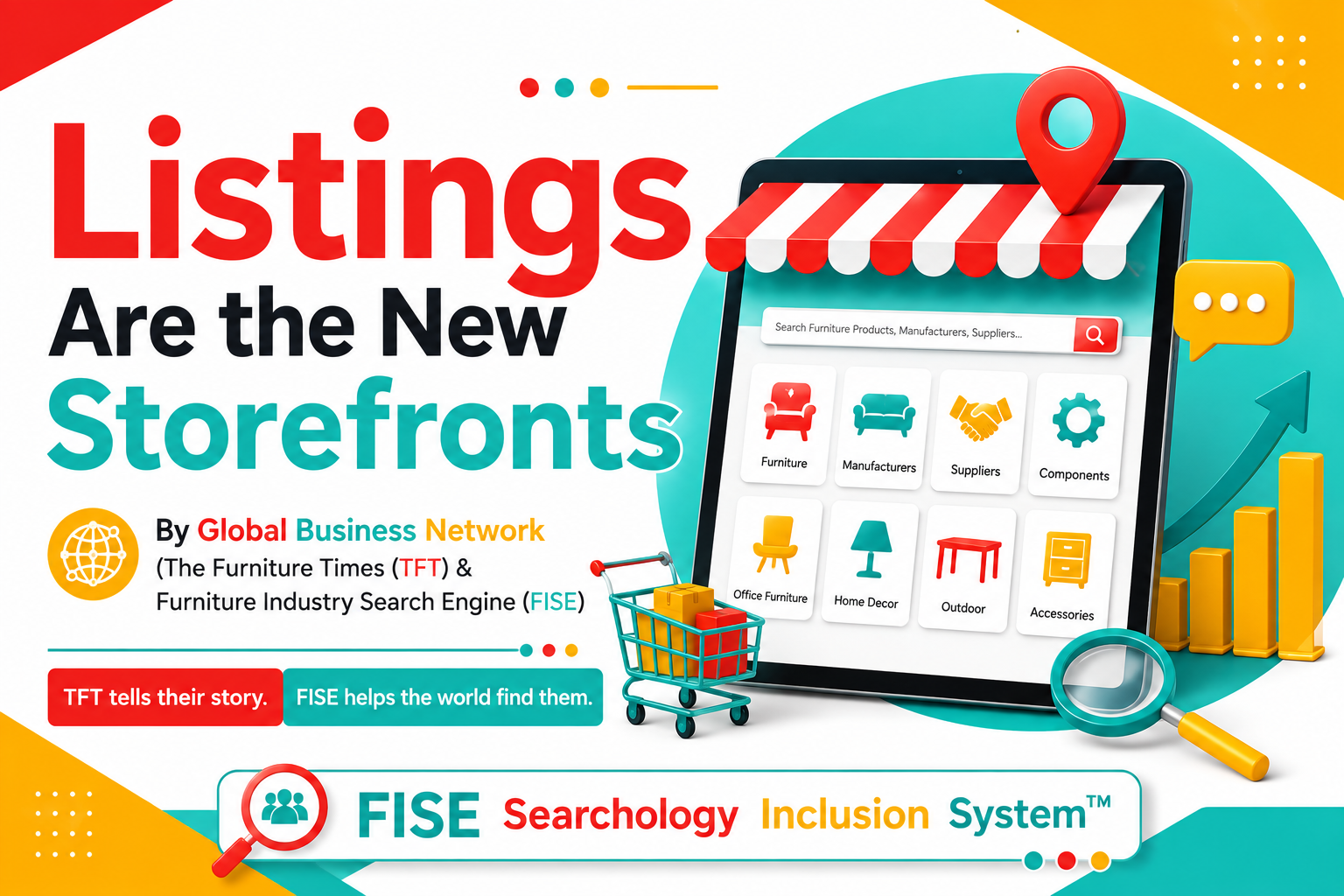
TFT tells their story. FISE helps the world find them.
This distinction is central to understanding why business discovery matters.
Imagine an international buyer searching for furniture manufacturers. The buyer may have specific requirements involving materials, product categories, production capabilities, or geographic markets.
A business discovery platform can help organize relevant information so that buyers have a more practical starting point for identifying potential suppliers.
The same principle applies to retailers, designers, distributors, importers, exporters, artisans, and other participants across the furniture ecosystem.
FISE represents an industry-focused approach to making business information more accessible and discoverable.
Its larger vision is not simply to give companies another place to publish their names. It is to strengthen the relationship between business information and the people searching for relevant products, services, and industry connections.
For participating businesses, useful information may include:
-
Business name and identity.
-
Product and service categories.
-
Manufacturing and production capabilities.
-
Materials and specializations.
-
Professional contact information.
-
Business descriptions and areas of expertise.
-
Relevant images and product information.
-
Geographic and market information.
The more useful and accurate the information, the easier it becomes for prospective customers to understand what a business offers.
A discovery platform cannot guarantee sales, international contracts, or search engine rankings. Those outcomes depend on many factors, including buyer demand, competition, quality, pricing, logistics, and business responsiveness.
But it can contribute to the first important step: helping businesses become easier to discover.
FISE LIVE: Moving Beyond Passive Business Visibility
Business visibility should not be limited to having a name displayed on a digital platform.
Modern audiences expect information that is useful, engaging, and accessible. They want to understand businesses, explore offerings, and identify opportunities to communicate.
FISE LIVE forms part of the wider FISE ecosystem, extending the vision of business discovery into a more connected digital environment.
The concept is particularly relevant in an economy where businesses increasingly need ways to present themselves beyond static information.
Consider a furniture manufacturer introducing a new collection. An artisan showcasing a distinctive product. A business explaining its manufacturing capabilities. A supplier introducing its services to potential partners.
These are examples of how more interactive digital experiences can support business communication and industry engagement.
For SMEs and emerging companies, the larger opportunity is to move from simply having an online presence toward developing a more meaningful digital identity.
The value of FISE LIVE will ultimately depend on the experiences, features, accessibility, and engagement opportunities it delivers to participating businesses and audiences.
The principle remains important: businesses need more ways to be seen, understood, and approached by the people who matter to their growth.
FISE Searchology Inclusion System™: The Global Visibility Engine for Businesses the Digital Economy Often Overlooks
The invisible business problem becomes particularly serious when considering SMEs, artisans, makers, and grassroots creators.
These businesses and individuals may possess exceptional skills, innovative products, and valuable experience. However, they frequently lack the resources required to compete for digital attention.
Large companies can invest in marketing departments, advertising campaigns, professional websites, search strategies, and international promotional activities.
Smaller businesses often have to manage everything themselves.
A furniture artisan may spend most of the day producing goods rather than promoting them. A small manufacturer may prioritize machinery, workers, and orders over digital marketing. A grassroots creator may have an excellent product but limited knowledge of how to establish a recognizable online presence.
The FISE Searchology Inclusion System™ is positioned around a larger ambition: to create a global visibility engine for SMEs, artisans, makers, and grassroots creators.
It is not simply about adding more business listings to the internet.
It represents a wider vision built around four important dimensions.
More Than a Business Listing System: A Livelihood System
Every small business represents more than a commercial operation.
It may support a family, employ local workers, provide opportunities to young people, preserve traditional craftsmanship, or sustain an entire community.
A small furniture workshop can create livelihoods for carpenters, upholsterers, designers, suppliers, delivery workers, and other service providers.
An independent artisan can preserve valuable skills while generating income from products that reflect years of experience.
A grassroots creator can turn an idea into a business that provides financial independence and contributes to the local economy.
When businesses become easier to discover, they may have more opportunities to connect with relevant customers and partners.
This is the livelihood dimension of the FISE Searchology Inclusion System™ vision.
The goal is to connect digital visibility with meaningful economic participation.
A listing alone cannot create a sustainable livelihood. Businesses still need quality products, reliable operations, customer trust, competitive pricing, and consistent demand.
But discoverability can help open doors that might otherwise remain closed.
The objective is not merely to make a business visible. It is to help create opportunities that support the people and communities behind it.
More Than Technology: A Human Impact System
Technology should not be measured only by the number of features it offers.
Its deeper value lies in what it helps people achieve.
If a digital platform helps a small manufacturer reach a new buyer, that connection may contribute to additional orders and employment.
If an artisan gains access to a wider audience, that exposure may help preserve a traditional craft.
If an SME becomes easier to identify, it may have an opportunity to establish a relationship that supports its next stage of growth.
These are the human outcomes that make digital inclusion important.
The FISE Searchology Inclusion System™ places people at the centre of the visibility conversation.
It recognizes that behind every company name is an entrepreneur, a worker, a family, or a community with ambitions and challenges.
A human impact system should therefore focus on more than digital participation. It should encourage meaningful opportunities, accessible information, and business connections that can create value.
More Than Search: A Search Revolution
Search has become one of the most important starting points for modern business discovery.
Customers search for products. Retailers search for suppliers. Manufacturers search for materials. Entrepreneurs search for partners. Investors search for opportunities.
But when business information is incomplete, fragmented, or difficult to interpret, relevant businesses may remain outside the discovery process.
A search revolution should not simply produce more information. It should make useful information easier to find and understand.
This means organizing business identities, product categories, services, capabilities, and relevant industry information in ways that support meaningful discovery.
For SMEs, this creates an opportunity to present their businesses more professionally.
For buyers, it can support the process of identifying potential suppliers.
For artisans and makers, it can help communicate the nature and value of their work.
The FISE Searchology Inclusion System™ vision recognizes that discovery must become more inclusive, relevant, and accessible if the digital economy is to create opportunities for a wider range of businesses.
More Than an Online Profile: A Digital Identity Movement
Many businesses have an online presence but lack a coherent digital identity.
Their business name may appear differently across platforms. Their contact information may be outdated. Their product descriptions may be incomplete. Their capabilities may not be clearly explained.
This creates uncertainty for prospective customers.
A professional digital identity helps answer essential questions:
Who are you? What do you offer? Who do you serve? What makes your business different? How can people contact you?
For a manufacturer, it may mean clearly explaining production capabilities and product categories.
For an artisan, it may mean presenting craftsmanship, materials, and the story behind the work.
For an SME, it may mean establishing consistent business information across relevant digital channels.
For a grassroots creator, it may mean building a recognizable identity around a product, service, or idea.
The FISE Searchology Inclusion System™ vision recognizes digital identity as an essential foundation for business discovery.
If the world cannot clearly identify your business, it becomes harder for the world to understand your value.
Why Small Businesses Are Losing the Visibility Battle
One of the biggest misconceptions about digital business growth is that simply creating a website or social media account is enough.
It is not.
A website can exist without attracting relevant visitors. A social media page can have hundreds of posts without generating qualified enquiries. A product catalogue can look professional but remain difficult to discover through relevant searches.
Businesses need to understand the difference between having a digital presence and building discoverability.
Here are some of the most common mistakes that keep companies invisible.
Incomplete business information: Businesses often fail to provide sufficient details about their products, services, location, capabilities, and contact information.
Unclear positioning: When customers cannot understand what a company specializes in, they may move to another provider.
Inconsistent digital identity: Different business names, outdated contact details, and inconsistent branding can create confusion.
Weak product descriptions: Generic descriptions do not adequately communicate product features, materials, applications, or customer benefits.
Limited storytelling: Businesses that never communicate their journey, expertise, or achievements miss opportunities to build recognition and credibility.
No clear customer action: Visitors may discover a business but have no obvious way to request information, quotations, or consultations.
Ignoring search behaviour: Businesses that do not consider how customers search for their products and services may struggle to appear in relevant discovery journeys.
The solution is not necessarily to spend more money on advertising.
It is to become more strategic about how business information is created, organized, communicated, and discovered.
The New Business Reality: Visibility Is Becoming Part of Competitiveness
Competition is no longer restricted to businesses operating on the same street, in the same city, or even in the same country.
A local manufacturer may compete for attention against suppliers from multiple international markets.
A small furniture retailer may compare products from domestic and overseas manufacturers.
A customer looking for a specialist service may evaluate companies based on the information available online before making contact.
This means businesses need to think beyond traditional market boundaries.
Digital visibility is increasingly connected to competitiveness because it influences the opportunity to enter a customer’s consideration process.
A company may offer better quality, more suitable pricing, or more specialized expertise. But if potential customers never encounter its business information, those advantages may never be considered.
This is why companies must treat discoverability as a business development priority rather than an occasional marketing activity.
The future will reward businesses that combine real value with the ability to communicate that value effectively.
How to Make Your Business Visible: Seven Actions to Take Now
Understanding the invisible business problem is important. Taking action is what changes the situation.
Businesses do not need to transform everything overnight. They need to begin with the foundations that make their identity and offerings easier to understand.
1. Audit Your Existing Digital Presence
Search for your business name online.
Look at what customers can actually see. Is the information accurate? Can they understand your products and services? Are your contact details correct? Does your business appear professional?
Identify missing information and inconsistencies.
Do not assume your digital presence is strong simply because you have a website.
2. Build a Clear Business Identity
Create a consistent description of your business.
Explain what you do, who you serve, what products or services you provide, and what makes your business distinctive.
Use accurate business information across your website, professional profiles, relevant directories, and industry platforms.
3. Make Your Products and Services Easier to Discover
Avoid relying on vague descriptions.
Use clear product names, relevant categories, accurate specifications, and informative descriptions.
For example, a furniture manufacturer should communicate whether it produces outdoor furniture, bedroom furniture, office furniture, hospitality furniture, or customized furniture.
The more clearly a business explains what it offers, the easier it becomes for relevant audiences to understand its relevance.
4. Tell Your Business Story
People should understand the business behind the product.
Share your experience, expertise, manufacturing journey, craftsmanship, achievements, and purpose.
Use informative articles, professional photographs, interviews, and relevant industry content to communicate your value.
This is where platforms focused on business storytelling, such as The Furniture Times, become relevant to the wider visibility ecosystem.
5. Strengthen Your Industry Presence
Do not depend entirely on one social media platform.
Explore relevant industry networks, business communities, professional associations, media platforms, and discovery systems.
Your objective should be to build a consistent presence where your target audience is likely to search for businesses like yours.
6. Make It Easy for Customers to Contact You
A business discovery opportunity should lead somewhere.
Include a clear enquiry process, accessible contact details, professional communication channels, and a straightforward next step.
Respond promptly and provide useful information when prospective customers approach you.
7. Measure the Results
Track more than impressions and followers.
Monitor relevant enquiries, qualified leads, website visits, referral sources, customer conversations, quotation requests, and completed sales.
This will help you understand whether your visibility efforts are attracting the right audience.
The ultimate objective is not simply to be seen. It is to become discoverable by people who have a genuine reason to engage with your business.
The Role of AI, Search Engines, and the Future of Business Discovery
The way information is discovered is continuing to evolve.
Search engines, artificial intelligence tools, digital assistants, and generative search experiences are changing how people research products, compare suppliers, and identify businesses.
People increasingly ask direct questions rather than searching only with short keywords.
A buyer might ask:
-
Where can I find reliable furniture manufacturers?
-
Which suppliers specialize in outdoor furniture?
-
How can I identify furniture manufacturers in Malaysia?
-
Where can I find independent furniture artisans?
-
Which companies provide customized furniture solutions?
-
How can small businesses reach international buyers?
These questions highlight why businesses need clear, consistent, and useful digital information.
A business should not assume that publishing a few keywords will automatically make it visible in AI-generated answers or search results.
Instead, it should focus on building a trustworthy digital presence with accurate descriptions, informative content, relevant industry information, clear product categories, and consistent business details.
For businesses, this means thinking beyond traditional online promotion.
It means creating information that helps people and digital systems understand the business.
This is closely connected to the wider purpose behind the FISE Searchology Inclusion System™: supporting a more organized and inclusive approach to digital business identity and discovery.
As search experiences evolve, companies that invest in accurate, useful, and accessible information will be better positioned to participate in changing discovery environments.
Why Business Visibility Must Become a Livelihood Priority
There is an important difference between treating visibility as a marketing expense and recognizing it as a potential contributor to sustainable livelihoods.
For a large company, increased visibility may support brand recognition and market expansion.
For a small business, it may create an opportunity to secure its next customer.
For an artisan, it may help sustain a craft.
For a grassroots creator, it may provide an opportunity to introduce an idea to a wider audience.
For a small manufacturer, it may support new supplier relationships and business enquiries.
The impact can extend across an entire network.
A furniture manufacturer receiving an additional order may need more materials. More materials may create demand for suppliers. Increased production may require additional workers. A successful business relationship may support transportation, logistics, and other service providers.
This illustrates why business discoverability can matter beyond an individual company.
When smaller businesses have better opportunities to participate in markets, the potential benefits can extend into the communities and networks that support them.
The vision behind FISE Searchology Inclusion System™ is therefore broader than online visibility.
It is about recognizing that discoverability can be connected to livelihoods, human impact, economic participation, and global opportunity.
Global Business Network: Making Business Connectivity More Meaningful
Global Business Network recognizes that modern business growth requires more than isolated promotional activities.
Entrepreneurs need connections. Companies need relevant audiences. Manufacturers need buyers. Suppliers need customers. Startups need opportunities to introduce their solutions.
But connections become meaningful when people can understand one another’s capabilities and identify areas of mutual value.
This requires a stronger foundation of business information and digital identity.
A connected business environment should make it easier to identify relevant enterprises, understand their offerings, communicate with them, and explore opportunities for collaboration.
The invisible business problem reminds us that countless companies may have something valuable to contribute but remain outside the networks where opportunities are being discussed.
Global Business Network’s broader vision connects with the importance of making businesses more visible, accessible, and discoverable.
Through the complementary storytelling and discovery vision of The Furniture Times and FISE, alongside FISE LIVE and the FISE Searchology Inclusion System™, the objective is to encourage a more inclusive business ecosystem.
The world does not lack talented businesses. It needs better ways to discover them.
The Future Is Not Just About Building Businesses. It Is About Making Them Discoverable.
For years, entrepreneurs have been told to build better products, improve services, strengthen brands, and work harder.
All of these things remain important.
But there is another question every business owner must now ask:
How easily can the right people discover what I have built?
Because the reality is uncomfortable. A business can invest years in developing a product and still remain unknown. An artisan can perfect a craft and still struggle to reach customers. A manufacturer can have the capacity to serve international markets and still miss opportunities because its digital identity is incomplete.
The invisible business problem will not disappear simply because companies publish more content or create additional social media accounts.
It requires a more deliberate approach to digital identity, business storytelling, structured information, and relevant discovery.
This is the opportunity behind the Global Business Network perspective and the wider ecosystem represented by TFT, FISE, FISE LIVE, and the FISE Searchology Inclusion System™.
TFT tells their story.
FISE helps the world find them.
FISE LIVE expands the wider vision of digital engagement.
The FISE Searchology Inclusion System™ advances the ambition of creating a global visibility engine for SMEs, artisans, makers, and grassroots creators.
Together, these concepts represent an important shift in how businesses should think about being present in the digital economy.
Not just being online.
Not just having a profile.
Not just publishing content.
But becoming easier to discover, understand, and approach.
Conclusion: Your Business May Be Invisible Today. It Does Not Have to Stay That Way.
The invisible business problem is one of the most underestimated barriers to business growth.
It affects companies with valuable products, skilled teams, meaningful experience, and genuine ambitions. It affects manufacturers that want to reach international buyers, artisans who deserve wider recognition, SMEs that need more opportunities, and grassroots creators whose work remains outside mainstream visibility.
The challenge is not always a lack of business value.
Sometimes, the challenge is that the value is not being discovered.
That is why digital visibility must become part of every serious business growth strategy.
Global Business Network highlights the importance of stronger business connectivity. The Furniture Times provides the storytelling dimension. FISE represents the discovery vision. FISE LIVE contributes to the wider digital ecosystem. The FISE Searchology Inclusion System™ brings attention to the importance of inclusion, livelihoods, human impact, and global visibility.
The opportunity is to create a business environment where smaller enterprises are not overlooked simply because they have fewer resources to promote themselves.
But businesses must also take responsibility for their own digital identities.
Review your information. Improve your descriptions. Present your products professionally. Communicate your capabilities. Tell your story. Make it easy for customers to contact you. Explore relevant business discovery platforms and build a presence that reflects the value you deliver.
Do not wait until your competitors have established stronger visibility. Do not wait until another business captures the attention of the buyer who could have been your customer.
The longer your business remains difficult to find, the more opportunities you may miss.
Your next customer could be searching right now. Your next business partner could be looking for exactly what you offer. Your next opportunity could be one discovery away.
The question is whether your business is ready to be found.
Stop being the best-kept secret in your industry. Build your digital identity. Tell your story. Become discoverable.
Because in the modern business economy, being invisible is a risk no ambitious business should ignore.