

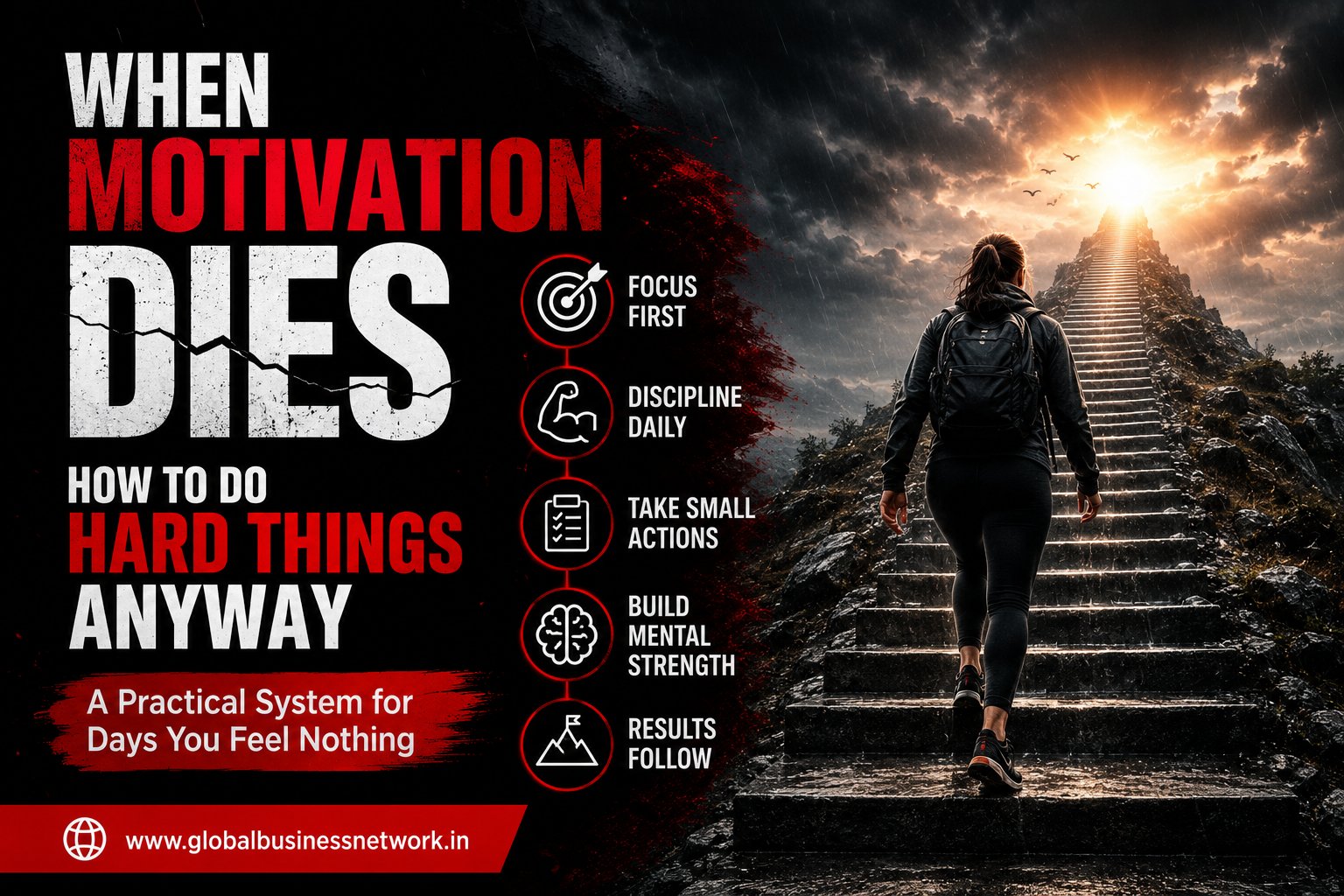
When Motivation Dies: How to Do Hard Things Anyway (A Practical System for Days You Feel Nothing)
The uncomfortable truth no one tells you
Most people don’t fail because they are incapable. They fail because they wait.
They wait for motivation.
They wait for energy.
They wait for the “right mood,” the “right time,” or a sudden burst of inspiration that almost never arrives when it matters.
And slowly, the life they want gets replaced by delay, distraction, and regret.
The truth is simple but brutal: motivation is unreliable. If your actions depend on it, your progress will always be inconsistent.
So the real question is not “How do I feel motivated?”
It is: How do I move forward when I feel nothing at all?
Why motivation keeps disappearing when you need it most
Motivation is emotional fuel, not structural support. It spikes when something is exciting, new, or rewarding. But it collapses under repetition, stress, boredom, or fear.
This is why:
- Starting feels easy, continuing feels heavy
- Big dreams feel exciting, daily effort feels draining
- Inspiration appears at night, disappears in the morning
Your brain is not broken. It is efficient. It avoids discomfort unless something stronger overrides it.
That “something stronger” is not motivation.
It is systems, identity, and friction control.
The shift that changes everything: from feeling to structure
People try to fix motivation. High performers design behavior.
Instead of asking:
- “How do I get myself to do this?”
They ask:
- “How do I make this unavoidable?”
This shift removes emotional negotiation from your life.
Because every time you debate with yourself, you lose energy before you even start.
The 5-part system to do hard things with zero motivation
1. Shrink the task until it loses resistance
Your brain rejects “big effort,” not “small action.”
Instead of:
- “Work out for an hour”
Start with:
- “Put on workout clothes”
- “Do 2 minutes of movement”
Once you start, momentum often takes over. If it doesn’t, you still win because you kept the chain alive.
Progress is built on entry, not intensity.
2. Use the 5-minute contract
Commit only to 5 minutes.
Not forever.
Not even “until finished.”
Just 5 minutes.
This removes pressure and bypasses resistance. The mind tolerates short discomfort more easily than open-ended struggle.
Once inside the task, continuing becomes easier than restarting later.
3. Remove negotiation triggers
Motivation dies in negotiation.
So remove questions like:
- “Do I feel like it?”
- “Should I do it now or later?”
- “Is this the right time?”
Replace them with fixed rules:
- “I start at this time, no matter what”
- “I do the first step immediately when I think of it”
Discipline is not intensity. It is reduced decision-making.
4. Design friction in your favor
Your environment is either helping you or slowing you down.
Make good actions easier:
- Keep tools visible
- Reduce steps to start
- Pre-set your workspace
Make distractions harder:
- Log out of apps
- Remove shortcuts
- Increase effort required to waste time
You do not rise to your goals. You fall to your environment.
5. Build identity, not just effort
The strongest internal shift is identity-based:
Not “I want to work hard”
But “I am someone who shows up even when I don’t feel like it”
This removes emotional dependence.
You stop acting based on how you feel and start acting based on who you are.
Identity reduces resistance because you are no longer “trying.” You are “being.”
The emotional reality behind consistency
There will still be days where nothing feels right.
Days where:
- Everything feels heavy
- Your mind argues with every task
- Rest feels more attractive than progress
Those days are not exceptions. They are part of the process.
The difference between success and stagnation is not the absence of those days.
It is what you do during them.
Even minimal action protects your future self from starting over.
A simple rule to remember when everything feels hard
If you cannot do everything, do something.
If you cannot do something big, do something small.
If you cannot do something small, do the first 30 seconds.
Because stopping completely is what breaks momentum permanently.
Final thought
You do not need a perfect mindset to build a better life.
You need a repeatable response to resistance.
Motivation will rise and fall, but structure does not.
And the people who change their lives are not the ones who always feel ready.
They are the ones who keep moving when they do not.