
In a world where artificial intelligence is no longer optional but essential, the gap between those who understand AI and those who ignore it is widening at an alarming speed. Every industry, from healthcare to marketing, finance to education, is being reshaped by intelligent systems that learn, adapt, and decide faster than humans ever could.
Yet here is the uncomfortable truth: most people are still using AI without truly understanding it.
And that is exactly where opportunity lives.
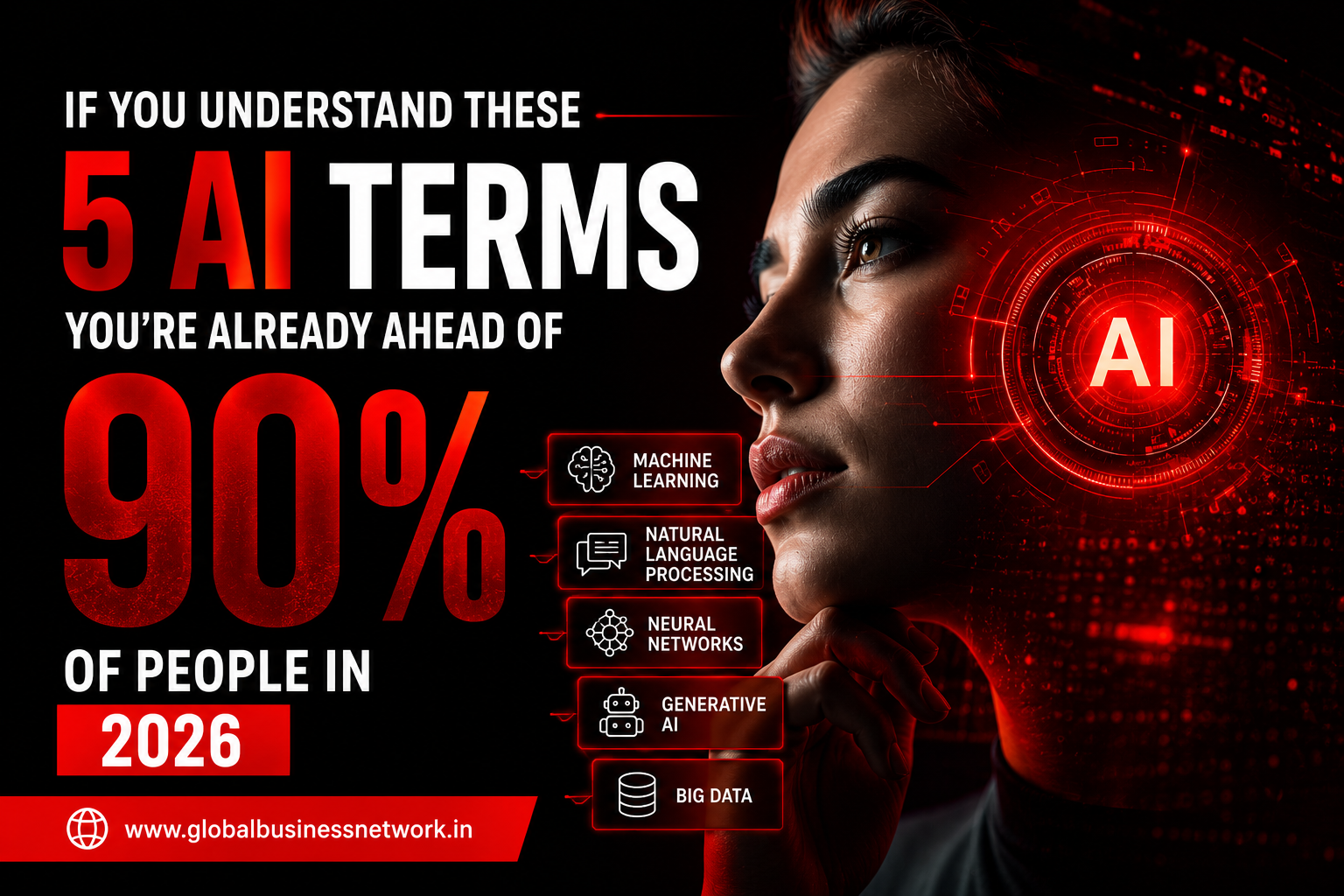
If you understand just five fundamental AI terms, you are already positioned ahead of the majority of people who are still struggling to catch up. Not because AI is complicated, but because clarity creates leverage. And leverage creates success.
Let’s break down these five terms in a way that is simple, practical, and powerful enough to change how you think about technology forever.
1. Artificial intelligence (AI): the foundation of modern intelligence systems
Artificial intelligence is not a single tool or app. It is the broader concept of machines designed to simulate human intelligence.
This includes learning from data, recognizing patterns, making decisions, and even generating content.
The urgency to understand AI is simple: it is now embedded in everything you use daily, from search engines to social media feeds, from recommendation systems to automated customer service.
If you do not understand AI at a basic level, you are essentially using a powerful system without knowing how it influences your choices.
2. Machine learning: how systems learn without being explicitly programmed
Machine learning is the engine behind most modern AI systems.
Instead of being manually coded for every task, machine learning allows systems to learn from data and improve over time.
Think of it like training a child. The more examples the system sees, the better it becomes at predicting outcomes.
This is what powers fraud detection in banking, product recommendations in e-commerce, and even medical diagnosis systems.
Understanding machine learning means understanding how decisions are increasingly being made by patterns rather than instructions.
3. Neural networks: the digital brain behind AI thinking
Neural networks are designed to mimic the structure of the human brain.
They consist of layers of interconnected nodes that process information step by step, refining outputs as data flows through them.
This is what allows AI to recognize faces, understand speech, and translate languages in real time.
The importance of neural networks is not just technical. It is transformational.
Because the more complex these networks become, the closer machines get to simulating human-like reasoning.
4. Large language models: the new era of communication with machines
Large language models, often called LLMs, are AI systems trained on massive amounts of text data to understand and generate human-like language.
They are the reason tools like chat-based assistants can write, summarize, explain, and even code.
But here is what most people miss: LLMs do not “think” like humans. They predict the next most likely word based on patterns.
This distinction is critical. It separates illusion from intelligence.
Understanding LLMs gives you an advantage in how you use AI effectively, especially in content creation, business automation, and problem-solving.
5. Prompt engineering: the skill that determines your AI success
Prompt engineering is the ability to communicate effectively with AI systems to get accurate and useful results.
It is not about coding. It is about clarity, structure, and intent.
The difference between a weak prompt and a strong prompt can be the difference between generic output and high-value insight.
In a world where AI tools are everywhere, the people who know how to ask the right questions will always outperform those who do not.
This is becoming one of the most valuable digital skills of the decade.
Why this knowledge matters more than ever
We are entering a phase where AI literacy is becoming as important as digital literacy once was.
Companies are already prioritizing candidates who understand AI fundamentals. Entrepreneurs are building entire businesses around AI tools. Students are using AI to accelerate learning at unprecedented speeds.
Those who ignore this shift are not just falling behind technology. They are falling behind opportunity.
And the gap is not closing. It is accelerating.
The urgent reality you cannot ignore
AI is no longer a future concept. It is a present reality shaping decisions, industries, and economies.
The question is not whether AI will affect your life. It already does.
The real question is whether you understand it well enough to benefit from it or be controlled by it.
Final thoughts
Understanding these five AI terms is not about becoming a technical expert. It is about gaining clarity in a world increasingly driven by intelligent systems.
Once you understand them, you will start seeing AI everywhere. More importantly, you will start using it more effectively in your personal and professional life.
And that is where the real advantage begins.